
LARRY BIRD WAS RIGHT
Drawing on the most comprehensive database ever compiled on NBA player mortality, this research examines how extreme height, ethnicity, and biological factors shape long-term health outcomes. While NBA players live longer on average than the general population, the findings reveal marked inequalities in causes of death. In particular, cardiovascular risk is higher among African ancestry players, whereas extreme height is associated with increased risks of both cancer and cardiovascular disease.
In February 2016, Jackie MacMullan, on ESPN, reported that Larry Bird was concerned because he believed he would die young. The recent premature deaths of iconic players such as Moses Malone, Darryl Dawkins, and Jerome Kersey, among others, not only alerted Bird, but also led players and specialized media to question what risks they faced based on their physical characteristics and NBA careers.
These events served as inspiration for us as researchers to explore how far we could resolve these questions with the limited information available. Thus began a 10-year journey of work, which has resulted in the publication of 3 articles between 2019 and 2026 attempting to obtain answers. In this way, the most complete body of evidence to date on mortality in the NBA has been constructed, not only examining how long these athletes live compared to the general population, but also unraveling the specific causes of death and associated risks, using advanced statistical methodologies.
The first challenge we faced was the lack of official mortality records in the NBA, so we had to build our own database from multiple sources. The work was arduous because we had to merge very diverse information on dates of birth, death, performance statistics, player characteristics (position, dominant hand) and other biological and contextual variables such as height, weight, or ethnicity. All of this while performing constant coding and validation processes, because we not only detected disparities between sources, but also had to verify that the coding had no errors.
The first study, published in Applied Sciences in 2019, analyzed a retrospective cohort of 3,985 players from the league’s founding in 1946 through 2015. The main objective was to identify factors associated with overall mortality (without specific causes) and compare players’ life expectancy with the U.S. general population. Using Cox proportional hazards models, adjusted by age and year, it was determined that mortality in the NBA is intrinsically associated with height and ethnicity. The data showed that taller players and African-American players had a higher instantaneous risk of death than shorter players or those of white ethnicity, respectively.
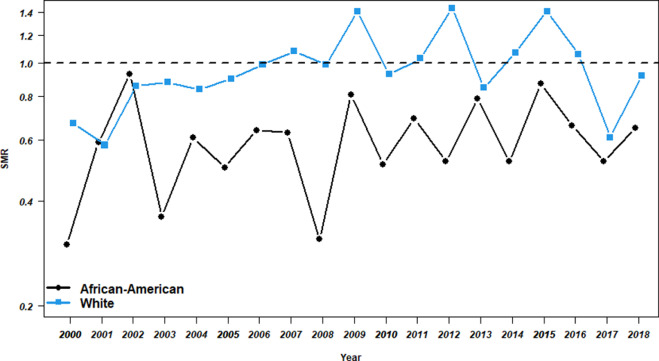
Despite these internal risk factors, the study confirmed the “healthy worker effect” phenomenon: NBA players have lower mortality rates than the U.S. general population. However, when broken down by ethnicity, a significant disparity was observed. While white players showed mortality rates generally lower but close to those expected for their reference population in certain years, African-American players maintained a relative survival advantage, with the gap from their reference population being different, suggesting complex socioeconomic and health dynamics. Additionally, it was confirmed that players’ life expectancy has progressively increased since the league’s inception.
Example interpretation of the results:
- Between white and African-American players, differences in median age at death of about 3 years (comparing players of the same height and debut year).
- There is a 2% increase in instantaneous risk of death for each additional centimeter of height.
Life Expectancy by Ethnicity and Debut Year
| Ethnicity | Height (cm) |
Year | Median Age (Life Expectancy) |
95% CI LL | 95% CI UL |
|---|---|---|---|---|---|
| White | 200 | 1950 | 79.6 | 78.6 | 81.0 |
| African-American | 200 | 1950 | 76.6 | 74.2 | 79.2 |
| White | 200 | 1960 | 81.0 | 79.7 | 82.6 |
| African-American | 200 | 1960 | 78.5 | 76.5 | 80.0 |
| White | 200 | 1970 | 82.8 | 80.6 | 85.1 |
| African-American | 200 | 1970 | 79.6 | 78.4 | 81.5 |
| White | 200 | 1980 | 84.3 | 81.7 | 87.8 |
| African-American | 200 | 1980 | 81.0 | 79.2 | 84.0 |
| White | 200 | 1990 | 85.9 | 82.6 | 91.2 |
| African-American | 200 | 1990 | 82.6 | 79.9 | 86.4 |
| White | 200 | 2000 | 87.4 | 83.7 | 94.3 |
| African-American | 200 | 2000 | 84.3 | 80.6 | 89.7 |
| White | 200 | 2010 | 89.0 | 84.5 | — |
| African-American | 200 | 2010 | 85.8 | 81.7 | 92.7 |
Estimates are based on Cox regression models for players with a height of 200 cm (2 meters).
Model I
Response variable: Time elapsed from the end of NBA career until death
| Variables | Estimate | SE | HR (95% CI) | p-value |
|---|---|---|---|---|
| Height | 0.02 | 0.005 | 1.02 (1.01–1.03) | <0.001 |
| Age at end of NBA career | 0.09 | 0.011 | 1.10 (1.07–1.12) | <0.001 |
| Year of last NBA season | −0.02 | 0.005 | 0.98 (0.97–0.99) | <0.001 |
| Ethnicity (African-Americans vs. White) | 0.35 | 0.113 | 1.41 (1.13–1.76) | <0.001 |
Model II
Response variable: Age at death
| Variables | Estimate | SE | HR (95% CI) | p-value |
|---|---|---|---|---|
| Height | 0.02 | 0.005 | 1.02 (1.01–1.03) | <0.001 |
| Year of first NBA season | −0.02 | 0.005 | 0.98 (0.97–0.99) | <0.001 |
| Ethnicity (African-Americans vs. White) | 0.31 | 0.109 | 1.37 (1.11–1.69) | 0.002 |
In 2022, the research team took a crucial step toward transparency and scientific reproducibility with the publication of a data paper in Data in Brief. This work not only updated the cohort through July 2019, expanding the sample to 4,374 players (412 active and 3,962 retired), but also rigorously revalidated biometric and demographic variables, given possible changes in information from the sources used. This study refined the database, correcting discrepancies in heights and dates through triangulation of sources (NBA.com, Basketball-Reference, historical newspaper records). It was confirmed again, with a more robust database and four additional years of follow-up, that height and African-American ethnicity remained significant predictors of mortality. The main difference from the previous study was finding a smoothing in the relative survival advantage of white players compared to the general white population, with the rest of the findings remaining practically identical, thus confirming the results of the first study.
The following figure shows the Standardized Mortality Ratios (SMR) comparing observed mortality with expected mortality in NBA players of African descent and whites. Expected mortality is calculated from the mortality rates of corresponding U.S. general populations
By making the data public, the study allowed the scientific community (physicians, statisticians, and player associations) access to a validated source to investigate health risks in this unique population.
The final link in this chain is the study we just published in 2026 in BMJ Open Sports & Exercise Medicine, which represents the most significant methodological and clinical advance. Focusing on the 864 players who died through July 2019, this study overcame the limitations of previous analyses by applying a competing risks approach and multiple imputation techniques (to statistically manage missing cases, i.e., without cause of death information), to analyze factors associated with different causes of death. To do this, we performed a laborious bibliographic search to find verifiable sources where the causes of death of all NBA players were stipulated. All the documentation we found has been made public along with the article, in order to facilitate replicability. Similarly, the database and programming codes have also been provided, consistent with open science principles.
The results of this latest study indicate that, from age 60 onwards, neoplasms (cancer) and cardiovascular diseases (CVD) are established as the main causes of death in the NBA. The most notable findings were:
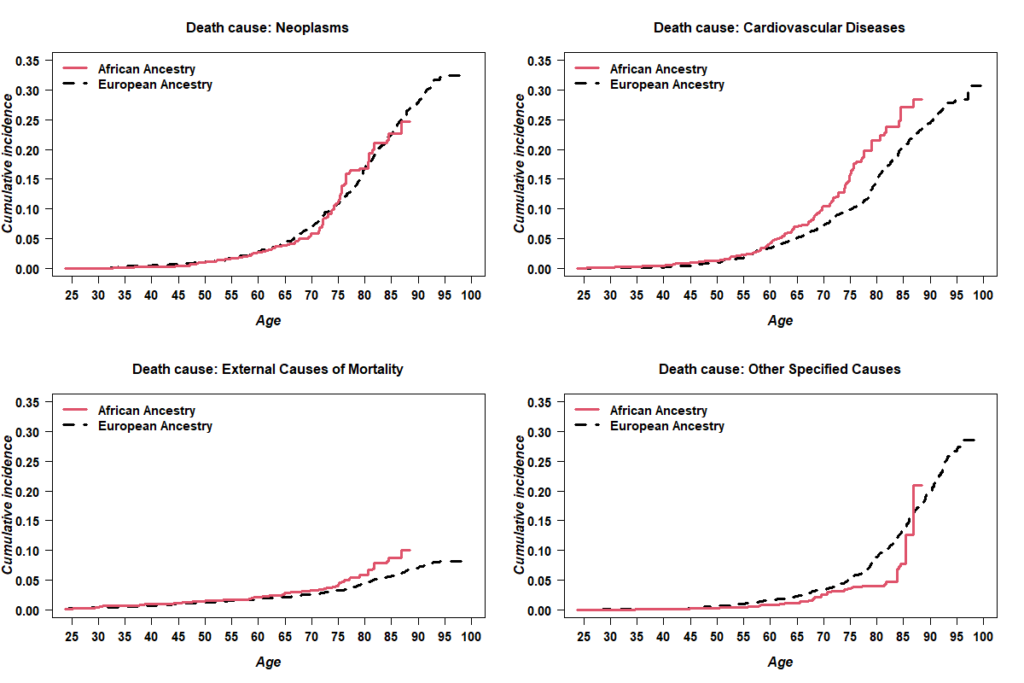
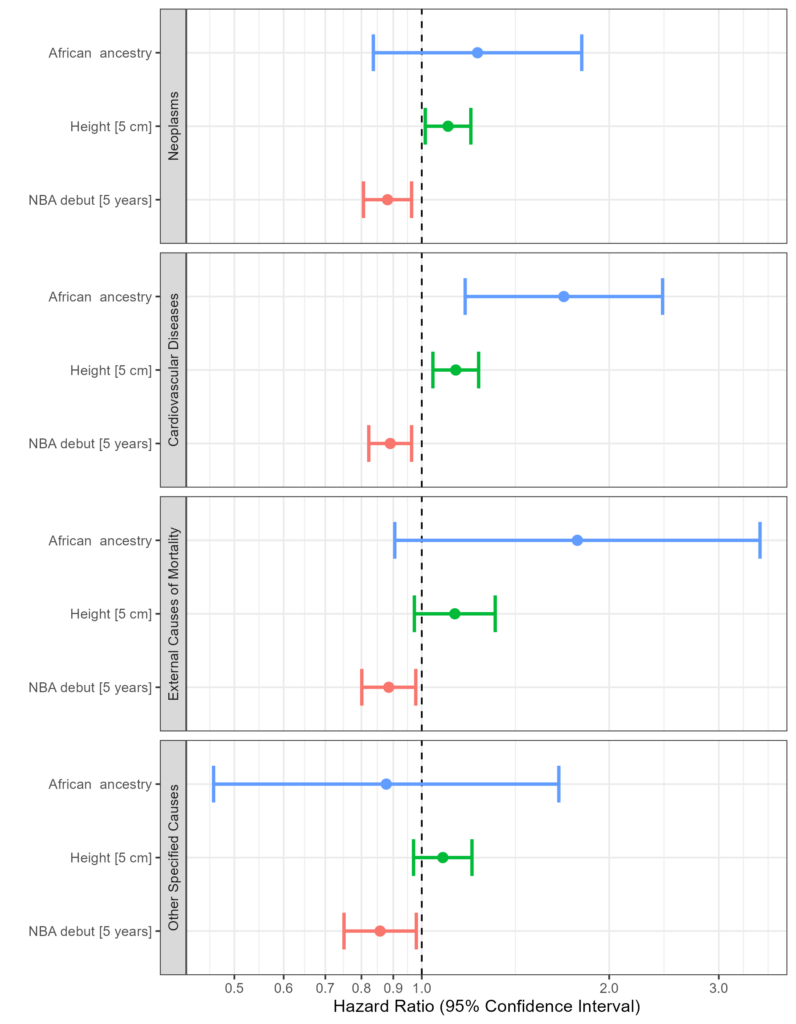
- Ethnic disparity in cardiovascular risk: There is a significantly greater cardiovascular mortality burden in players of African descent. The instantaneous risk of cardiovascular death is 69% higher in African-American players compared to those of European descent (white). At age 75, the cumulative incidence of CVD death was estimated at 15% for African-Americans versus 10% for those of European descent.
- Height as a risk factor: Unlike studies in the general population that associate greater height with lower cardiovascular risk, in this elite cohort height is positively associated with mortality from both neoplasms and cardiovascular diseases. For every 5 cm increase in height, the risk of death from both causes increases by 10% and 13%, respectively.
- External causes of death: A slightly higher incidence of deaths from external causes (suicides, accidents, homicides) is observed in African-American players, aligning with broader epidemiological trends in the U.S.
African-American NBA players face superior cardiovascular risk from a complex interaction of factors that goes beyond the court. We point to three main factors: genetic differences that predispose to more aggressive patterns of cardiac hypertrophy; historical inequalities in health access that persist after retirement, when the team’s elite medical care disappears; and an inherited socioeconomic gap, although salaries today are equitable, African-American veterans from past decades earned less, which impacts their quality of life and medical prevention in old age. This combination turns genetics into vulnerability when not accompanied by constant medical surveillance.
On the other hand, extreme height, with mean and median of 198 cm, 20 cm above what other studies consider “tall,” acts as an inverse mortality predictor in these athletes. While in the general population height protects from cardiac risk, in the NBA each additional 5 cm increases the probability of cardiovascular death by 13% and cancer by 10%. The mechanism is still to be clarified, but we speculate that there may be a U-curve: moderate height is protective, but as height approaches basketball norms, the heart is subjected to excessive mechanical work and the body to cell growth processes that may favor tumors. That is, being “too tall” for normal human standards deactivates cardioprotective benefits.
The following figure shows the estimated cumulative incidence in players of African and European descent
And the following figure illustrates the estimated hazard ratios (HR) and their 95% confidence intervals (CI), adjusted by year, associated with players’ ethnicity and height.
In essence, not all NBA players age with equal risk of death; African-Americans and the tallest have greater risk. Thus, sports retirement should not mean medical retirement, requiring personalized follow-up programs that consider these two specific vulnerabilities.
General Conclusions of the 3 Studies
The integration of these three works offers a unique perspective on the biology and sociology of the elite athlete. Together, these studies demonstrate that, although NBA players enjoy a longer life expectancy than the general population (with that advantage being more pronounced for players of African descent), they are not immune to specific risk patterns derived from their morphology and demographic context.
The accumulated evidence underscores two clinical imperatives:
- Specific cardiovascular monitoring: The notable disparity in cardiovascular mortality demands more aggressive and adapted primary prevention and screening strategies for players of African descent, both during their career and after retirement.
- Surveillance in very tall athletes: The positive association between height and cardiovascular and cancer mortality suggests that exceptionally tall athletes require specialized long-term health protocols, challenging the classic notion of cardiovascular protection associated with height observed in normative populations.
The high proportion of deaths of unknown cause underscores the urgent need to improve data collection systems for athletes. Improving the quality and accuracy of these records (through the creation of harmonized surveillance systems and the integration of clinical and public health data) is fundamental so that scientific research can generate evidence-based public health strategies, in order to protect athletes’ well-being during and after their careers, and extend their healthy lives.
In short, this trilogy of studies has provided, on one hand, a valuable database and documentation sources for the analysis and monitoring of causes of death of NBA basketball players, and results indicating that there is higher cardiovascular mortality in players of African descent and greater risk of dying from cardiovascular diseases and cancer among the tallest players. Thus we emphasize the need for ethnicity- and height-specific health interventions, and to prioritize medical follow-up of athletes during and after their professional careers.
We show below a schematic map with the chronology and results of the project.
Causes of Death in NBA Players and Associated Risk Factors
Research Timeline 2016-2026
José A. Martínez (Universidad Politécnica de Cartagena)
Martí Casals (University of Barcelona / Vic-UCC)
Klaus Langohr (Universitat Politècnica de Catalunya)
Julián Felipo (Mundo Deportivo)
• ECO2015-65637-P (MINECO/FEDER)
• MTM2015-64465-C2-1-R (MINECO/FEDER)
• 19884/GERM/15
Luciano Consuegra-Sánchez (Hospital Universitario Santa Lucía, Cartagena)
Luis Asensio-Payá (Hospital IMED Levante, Benidorm)
• PID2019-104830RB-I00
• PID2023-148033OB-C21
• SGR 01421
We show below a simple explanatory videos of the project highlights:
Authors
- José A. Martínez. Department of Business Economics, Universidad Politécnica de Cartagena member of European University of Technology EUT +, Spain. Email: [email protected]
- Klaus Langohr. Department of Statistics and Operations Research and Institute for Research and Innovation in Health (IRIS), Universitat Politècnica de Catalunya – BarcelonaTech, Barcelona, Spain. Email: [email protected]
- Luciano Consuegra-Sánchez. Cardiology Department, Hospital Quirón de Marbella y Quirón de Málaga, Málaga, Spain. Email: [email protected]
- Julián Felipo. Newsroom, Basketball Department, Mundo Deportivo, Barcelona, Spain. Email: [email protected]
- Luis Asensio-Payá. Cardiology Department, Hospital IMED Levante de Benidorm, Alicante, Spain. Email: [email protected]
- Martí Casals. National Institute of Physical Education of Catalonia (INEFC), University of Barcelona; Sport and Physical Activity Studies Centre (CEEAF), University of Vic-Central University of Catalonia (UVic-UCC), Spain. Email: [email protected]
References for the 3 studies
- Martínez, J. A., Langohr, K., Felipo, J., & Casals, M. (2019). Mortality of NBA Players: Risk Factors and Comparison with the General US Population. Applied Sciences, 9(3), 500. https://doi.org/10.3390/app9030500
- Martínez, J. A., Langohr, K., Felipo, J., Consuegra, L., & Casals, M. (2022). Data set on mortality of national basketball association (NBA) players. Data in brief, 45, 108615. https://doi.org/10.1016/j.dib.2022.108615
- Martínez, J. A, Langohr, K., Consuegra-Sánchez, L., Felipo, J., Asensio-Payá, L., & Casals, M. (2026). Causes of death in NBA players: a competing risks analysis. BMJ Open Sport & Exercise Medicine, 12 (1), e002917. https://doi.org/10.1136/bmjsem-2025-002917